Description
The Print
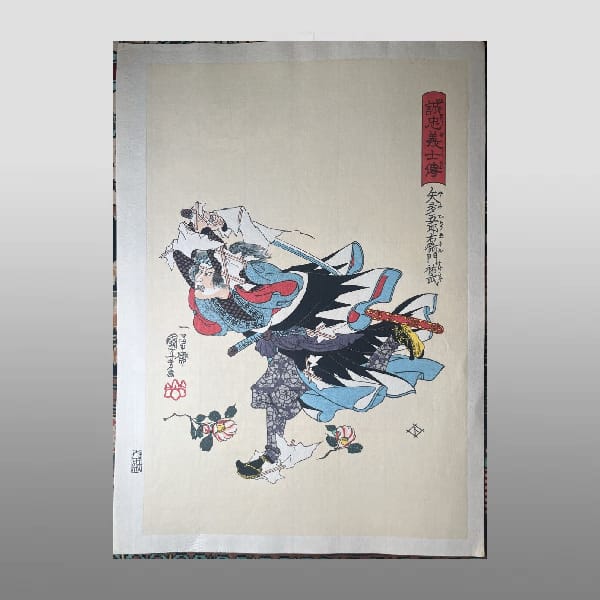
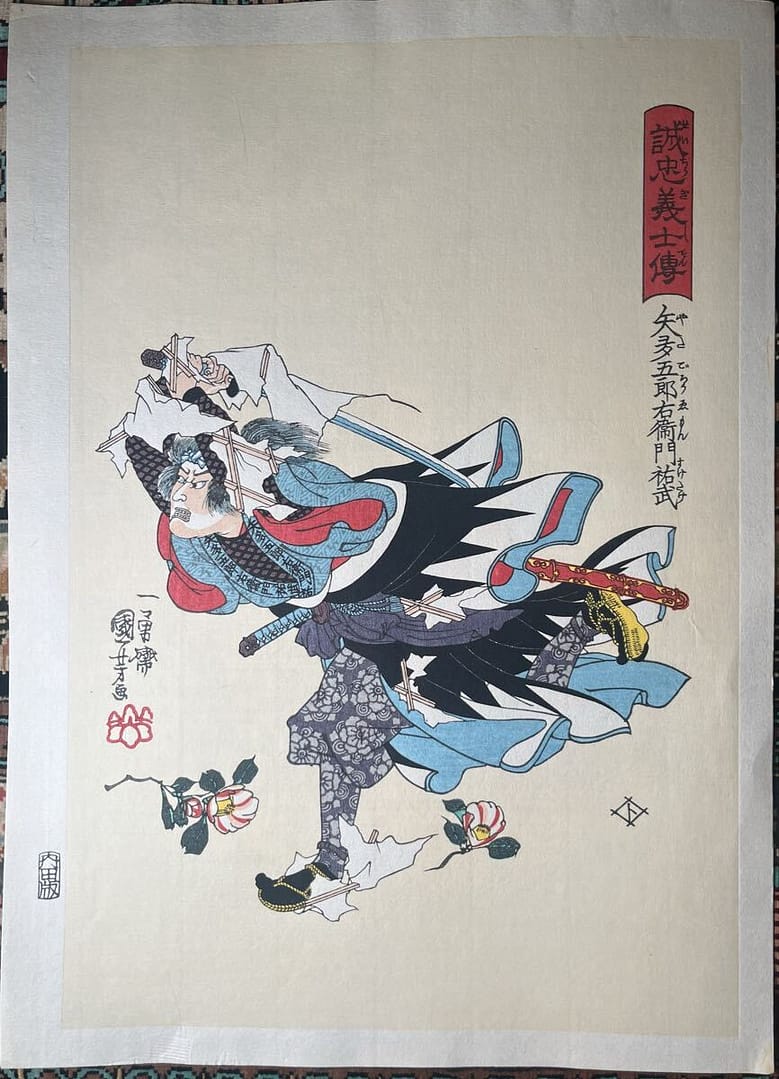
This is a fukkoku (復刻, later re-carved impression) of a design by Utagawa Kuniyoshi from his series Seichū Gishi Den (誠忠義士伝, “Biographies of the Loyal Retainers”), originally published in 1847–1848. The series depicts each of the forty-seven rōnin who carried out one of the most celebrated acts of revenge in Japanese history — the night raid on the mansion of Lord Kira Yoshinaka in the twelfth month of 1702. This print shows Yata Gorōemon Suketake (矢田五郎右衛門祐武), one of the retainers of the Akō domain.
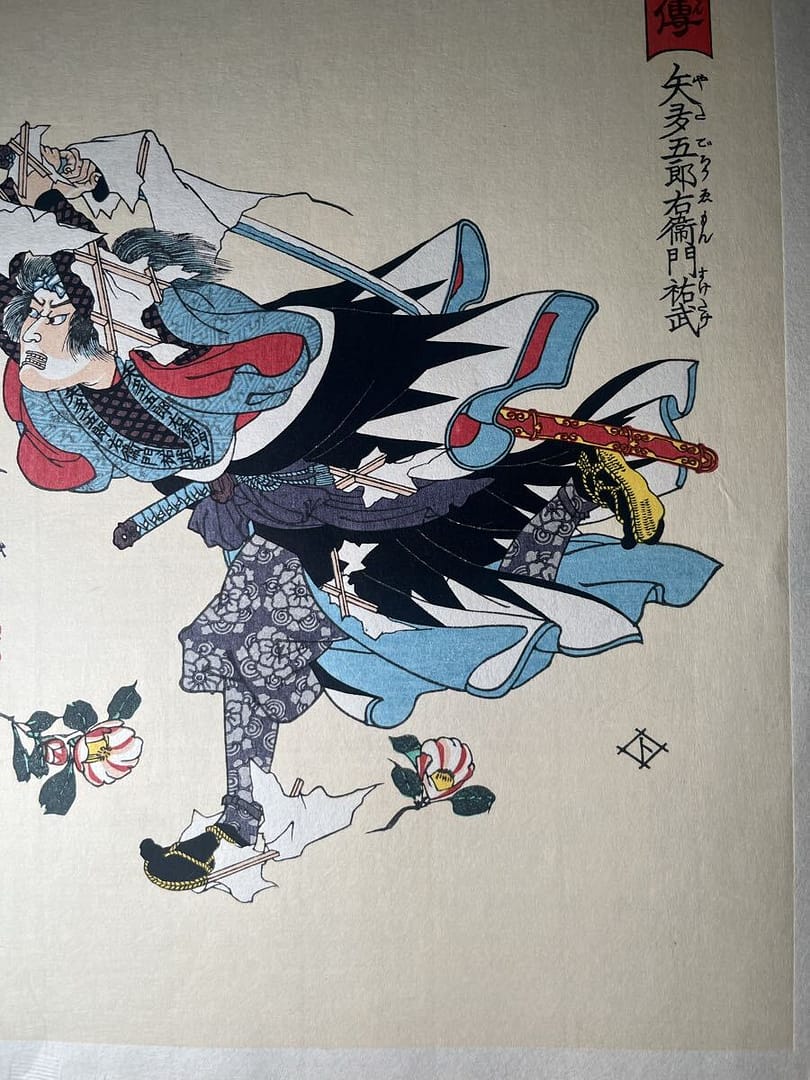
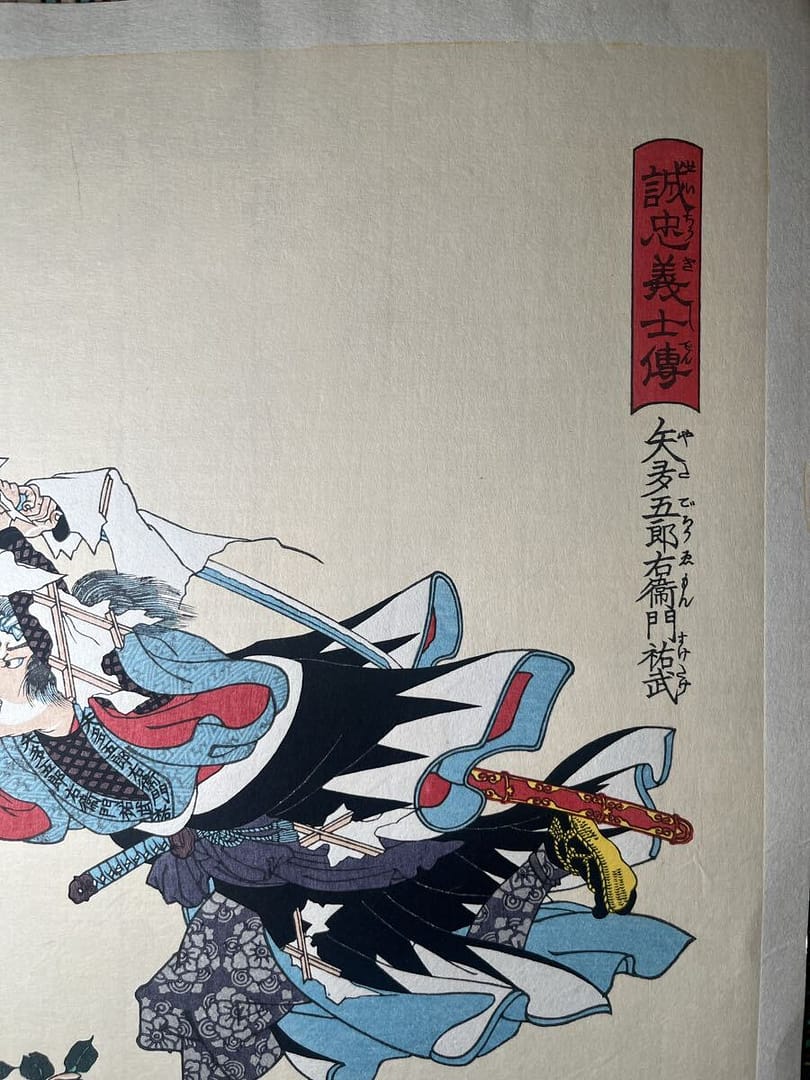
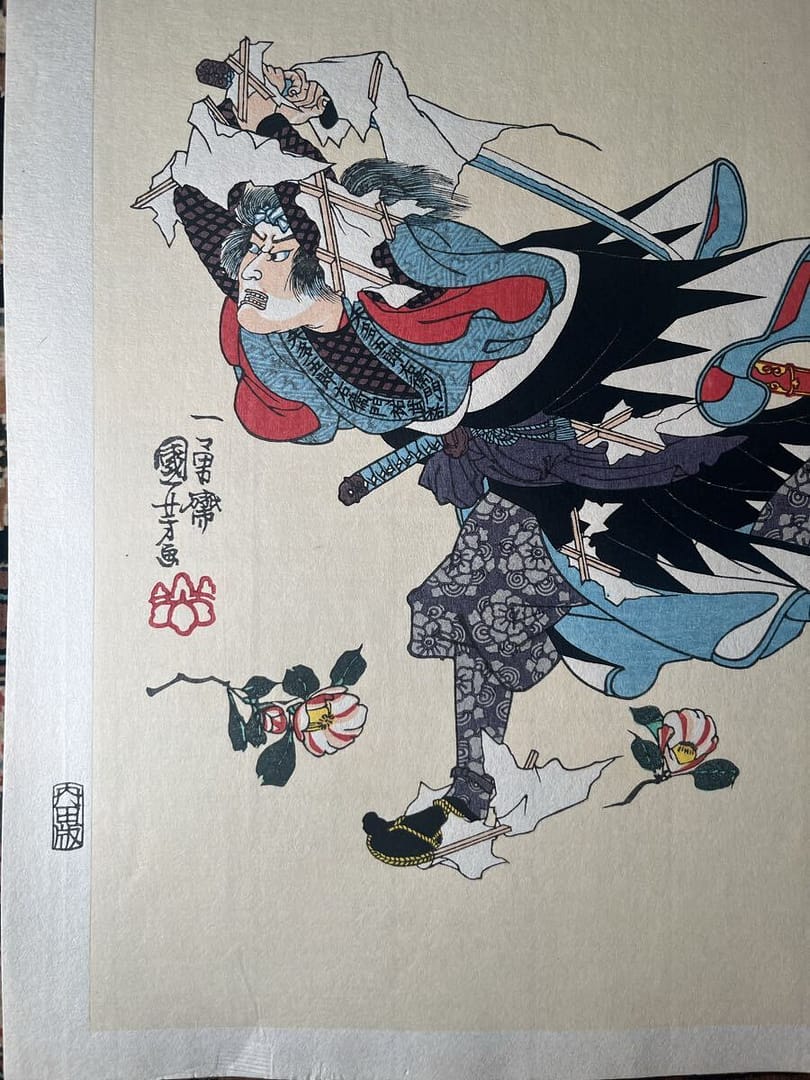
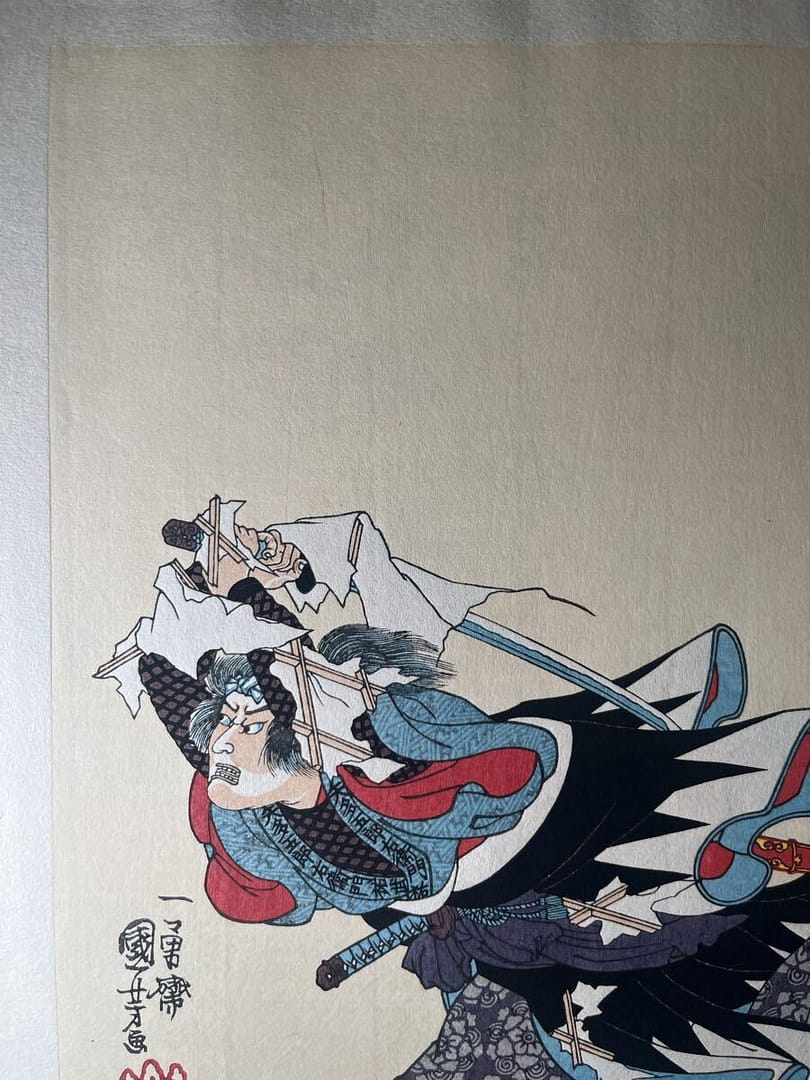
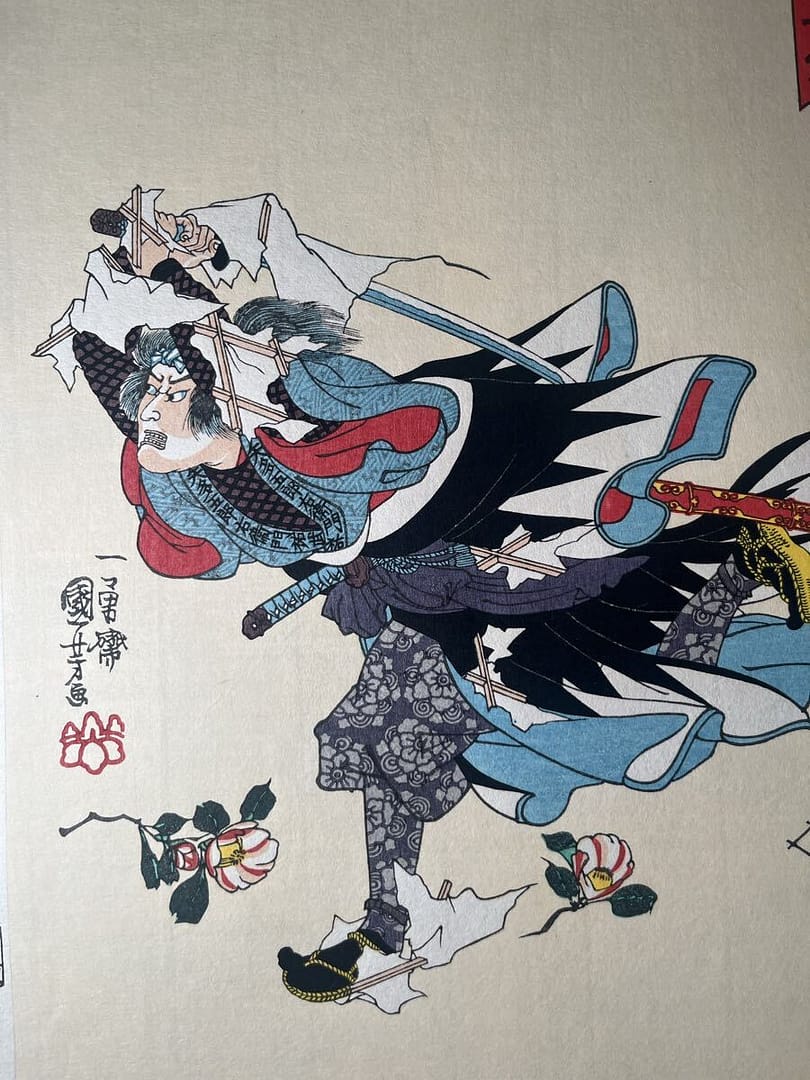
Yata Gorōemon is depicted in the midst of the assault, charging through a snow-covered lattice screen. He wears the distinctive black-and-white zigzag-patterned haori that identifies the Akō rōnin in most visual depictions of the raid. Beneath it, his hakama are richly patterned with floral motifs. An ornate sword scabbard in red and gold is visible at his side. At his feet, fallen camellia blossoms (tsubaki) lie scattered in the snow — a detail that anchors the scene in midwinter and carries its own associations: in Japanese visual culture, the camellia’s flower head drops whole from the branch, a motif traditionally linked to the fate of the warrior.
The composition is signed Ichiyūsai Kuniyoshi ga (一勇斎國芳画) with a red seal, and bears the series cartouche Seichū Gishi Den (誠忠義士傳) in red with furigana. The subject’s name, 矢多五郎右衛門祐武, appears in a separate cartouche.
This impression was published by Uchida Art Co. (内田美術書店, Uchida-ban) during the Shōwa period, using traditionally carved woodblocks and hand-printed in the mokuhanga technique.
The Artist
Utagawa Kuniyoshi (歌川国芳, 1798–1861) was one of the great masters of the late Edo-period ukiyo-e tradition. A student of Utagawa Toyokuni I, he became celebrated above all for his musha-e (武者絵, warrior prints), which brought a dynamic, muscular energy to scenes drawn from Japanese and Chinese history, legend, and literature. His depictions of warriors, monsters, and supernatural subjects are among the most inventive and technically ambitious of the entire ukiyo-e tradition. Kuniyoshi was also a significant designer of landscapes, bijin-ga (pictures of beautiful women), and satirical prints. His studio trained many of the important artists of the next generation, including Yoshitoshi, Yoshiiku, and Yoshitora. His work is held in major museum collections worldwide, including the British Museum, the Museum of Fine Arts Boston, and the Victoria and Albert Museum.
The Series: Seichū Gishi Den
Seichū Gishi Den is one of Kuniyoshi’s major series and among the best-known visual treatments of the Chūshingura (忠臣蔵, “Treasury of Loyal Retainers”) theme. First published in 1847–1848, the series comprises approximately fifty ōban nishiki-e prints, each depicting one of the forty-seven rōnin (with a few additional figures including their lord Asano Naganori and the enemy Kira Yoshinaka). The series belongs to the long tradition of Chūshingura imagery in Japanese art, but Kuniyoshi’s treatment is notable for its vividly individualized characterization of each retainer, often shown in a moment of decisive action during the night raid itself. The designs draw on the conventions of kabuki theatre — the rōnin in their matching haori, dramatic poses, and snow-laden settings — while bringing Kuniyoshi’s own flair for dynamic composition and fine textile patterns to the subject.
The Chūshingura Incident
The historical event behind this print is the Akō incident of 1701–1703. In 1701, Lord Asano Takumi no Kami Naganori of the Akō domain attacked the court official Kira Yoshinaka within the precincts of Edo Castle, reportedly after sustained provocation. Asano was ordered to commit seppuku that same day, his domain was confiscated, and his retainers became masterless samurai — rōnin. On a snowy night in the twelfth month of 1702, forty-seven of these former retainers launched a coordinated assault on Kira’s mansion in Edo, killing him and thereby avenging their lord’s dishonour. They then surrendered to the authorities and were ordered to commit seppuku themselves — an act that was seen as both a vindication of samurai loyalty (chūgi) and a tragic demonstration of the insoluble tensions between duty to one’s lord and duty to the law.
The incident became one of the most depicted narratives in Japanese culture, spawning kabuki and bunraku plays, novels, films, and enormous quantities of visual art. For European collectors, the Chūshingura story offers one of the most accessible entry points into Japanese warrior culture and the ethical world of Edo-period samurai society.
About This Impression (Fukkoku)
This is not an original Edo-period impression. It is a fukkoku — a later re-carved impression produced using traditionally carved woodblocks and hand-printed in the orthodox mokuhanga technique. It was published by Uchida Art Co. (内田美術書店), a Kyoto-based publisher established in 1923 that was designated by the Japanese government in 1942 as a qualified preserver of traditional woodblock-printing techniques. Uchida is known for high-quality fukkoku editions of classic ukiyo-e designs, working with skilled carvers and printers in the traditional manner. Their reproductions gained wide recognition in the postwar era, particularly among American and European collectors. Fukkoku editions offer access to iconic compositions at a fraction of the cost of Edo-period originals, which for prints from this series can reach well over €1,000 at specialist dealers.
Condition
Good to very good for a Shōwa-period fukkoku. Paper is clean with no obvious foxing, tears, or staining. Colours are vivid and well-preserved — the blues, reds, blacks, and yellows are strong throughout. Registration is accurate with no visible misalignment. Good margins on all sides. One minor mark in the upper left area, barely noticeable. Overall a presentable, displayable impression.
Framing & Display
Unframed, unmounted. The print can be framed in the Western manner with acid-free matting and UV-protective glass, or displayed in a traditional Japanese hanging scroll format. The bold composition and strong colours make it well-suited to both modern and traditional interiors. A popular approach for Chūshingura prints is to display multiple subjects from the series together as a group.