Description
The Print
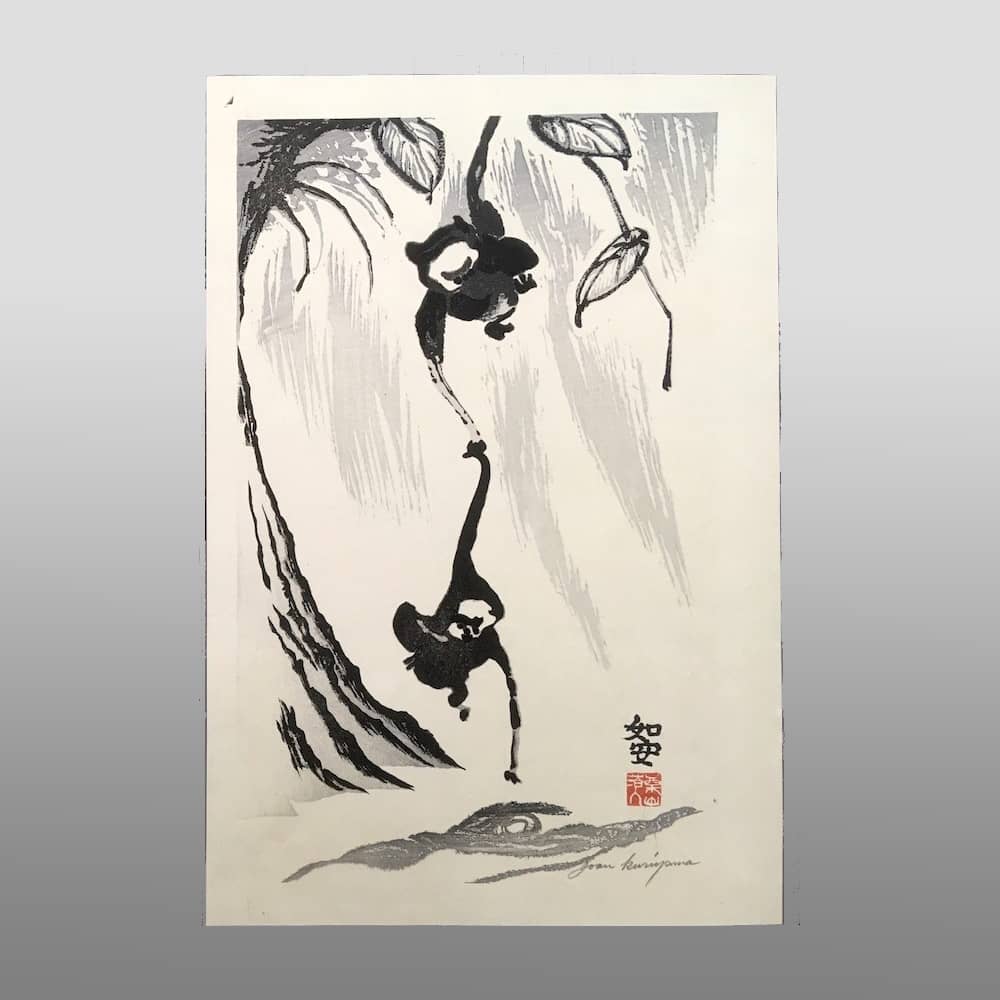
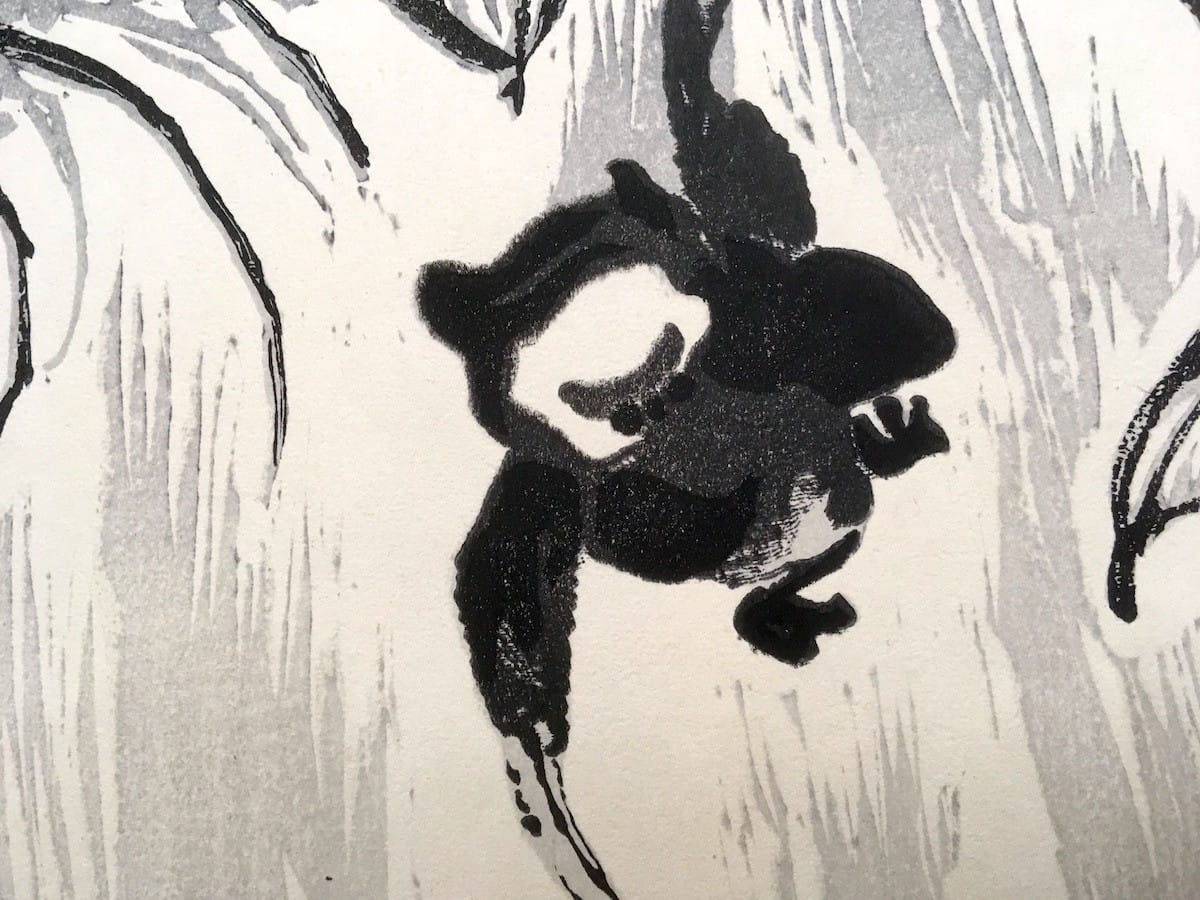
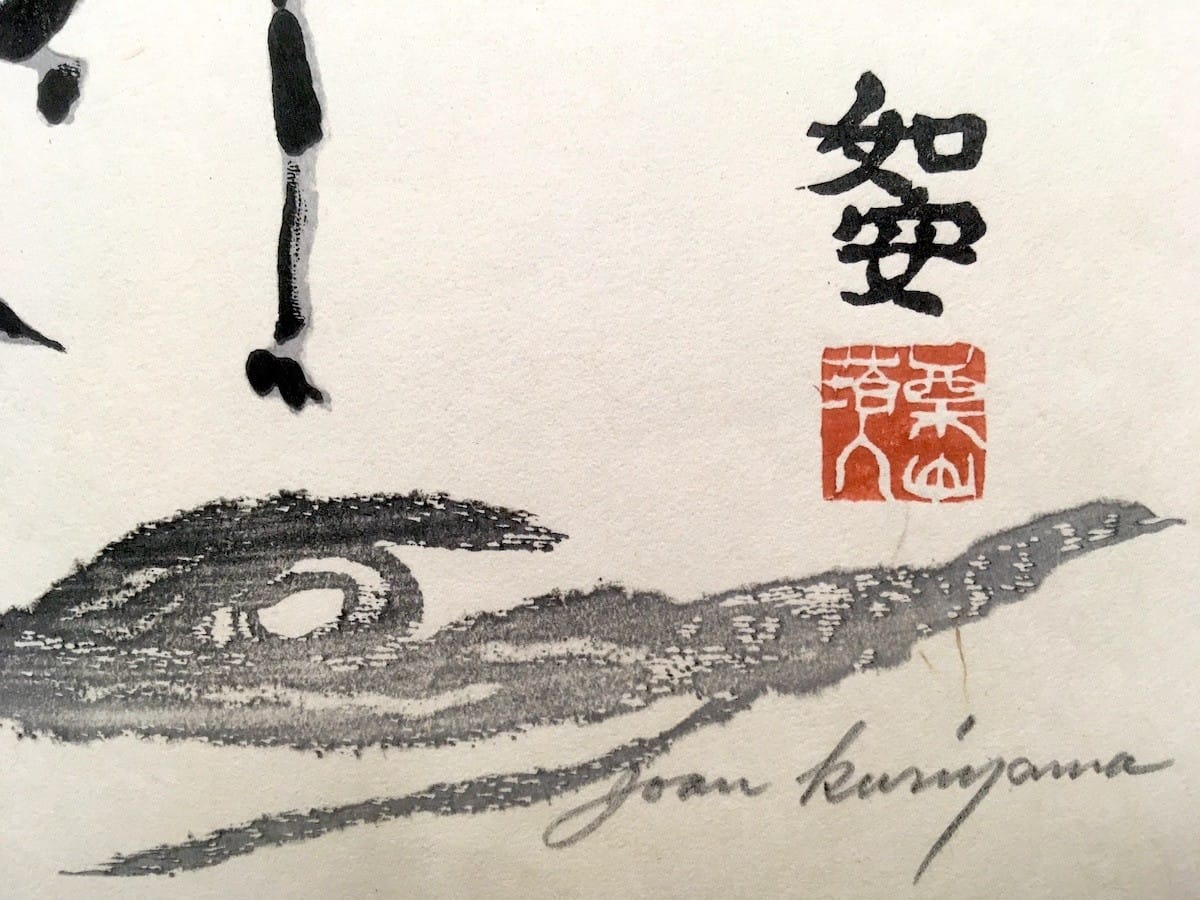
This expressive woodblock print depicts a pair of monkeys suspended from a gnarled branch over water, reaching toward what the viewer understands to be the moon’s reflection on the surface below. The composition is rendered in bold sumi ink with confident, calligraphic brushwork that captures the animals’ muscular tension and precarious balance. A red artist’s seal appears at the lower edge.
The subject belongs to one of the most enduring motifs in Zen Buddhist art: the monkey grasping at the moon’s reflection in water. The parable originates in Buddhist scripture and was given its most celebrated poetic form by Hakuin Ekaku (白隠慧鶴, 1686–1769), the great reformer of the Rinzai school of Zen. In his poem, the monkey — a metaphor for the restless, grasping mind — clings to a branch while reaching for the moon reflected in the pool below, never realising that what it seeks is merely an illusion. The teaching is that enlightenment cannot be grasped or possessed; it reveals itself only when the mind ceases its clinging.
This motif has a long lineage in Japanese and Chinese ink painting, from Muromachi-period hanging scrolls to Edo-period zenga (Zen paintings). In the shin-hanga tradition, it takes on a more refined graphic quality through the collaborative woodblock process, while preserving the spontaneous energy of ink painting.
The Artist
Joan Kuriyama is an uncommon name in the shin-hanga literature, and little biographical information is available. The print bears both a stamped seal and signature. Based on style, materials, and printing technique, the work dates to the early to mid-Shōwa period (c. 1950s). Collectors should note that many competent shin-hanga artists of this period remain under-documented in Western catalogues, which have historically focused on the major names associated with the publisher Watanabe Shōzaburō.
Condition
The print is in good condition overall, consistent with its age. Minor toning and handling marks are present, as expected for a work of approximately 70 years. No tears, holes, or significant damage. Suitable for framing and display.
Authenticity & Provenance
Original woodblock print (mokuhanga), not a reproduction. Sourced from a Japanese collection. The artist’s seal and signature are present on the print.
About the Zen Monkey Motif
The image of monkeys reaching for the moon’s reflection derives from a Buddhist Jātaka tale in which a troop of monkeys, upon seeing the moon reflected in a well, form a chain from a branch to seize it. The branch breaks and the monkeys fall into the water. The parable warns against mistaking appearances for reality — a core teaching in both Chan and Zen Buddhism. This subject was treated by numerous artists across centuries, including Hakuin himself (in his own zenga paintings), Ohara Koson, Ogata Gekkō, and the Muromachi-era painter Toki Tōbun, whose version is held by Princeton University Art Museum.
Framing & Display
We recommend conservation framing with acid-free matting and UV-protective glazing to preserve the print. A neutral or off-white mat in a simple dark frame suits the monochrome ink work well. The dramatic vertical composition and bold brushwork make this an effective piece for display in both traditional and contemporary interiors.